Changes that started on 27 October 2025
Supporting improved repairs and maintenance through increasing compliance powers
NSW Fair Trading has investigative and enforcement powers to help ensure owners corporations meet their legal duty to repair and maintain common property.
Fair Trading can use these powers to investigate potential breaches of this duty, including being able to require documents and answers, record a person, make records and enter premises.
Where a breach is found, Fair Trading can use a range of enforcement actions available to it, including:
- seeking an enforceable undertaking – this is a formal, voluntary written commitment made by an owners corporation to address a breach of its duty to maintain and repair common property.
- issuing a compliance notice – this would require an owners corporation to do specific actions such as fix damage, meet particular standards, or use licensed professionals.
- issuing a penalty infringement notice – this is a monetary penalty (fine) if an undertaking or compliance notice is not complied with.
- applying to the Tribunal for an order – an order can require an owners corporation to stop or fix a breach of its duty, or could be for the compulsory appointment of a strata managing agent to take over management of the scheme.
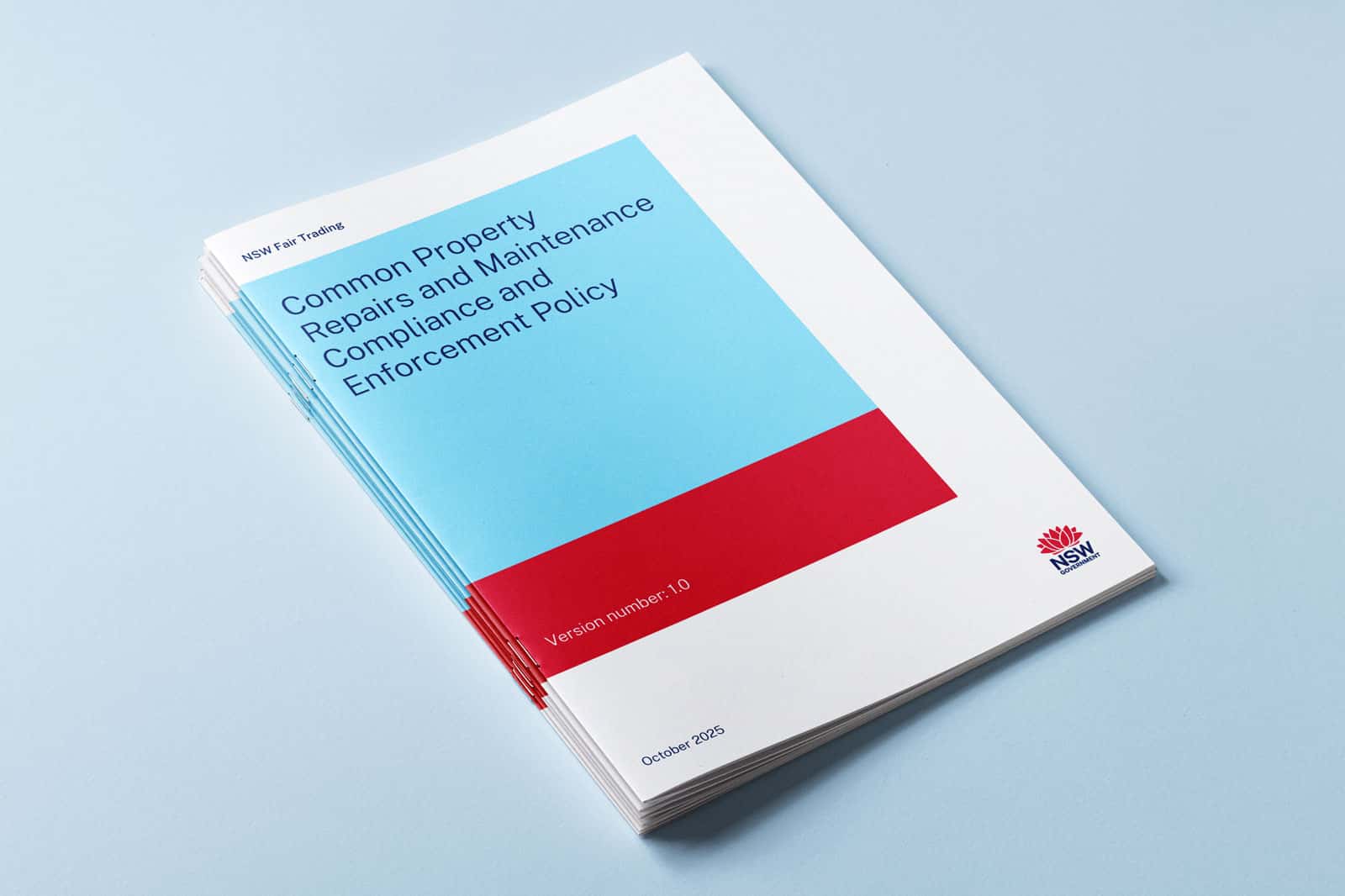
Download a copy of the new Common Property Repairs and Maintenance Compliance and Enforcement Policy.
What do strata schemes need to do?
Strata committees, strata managing agents and owners corporations must address any repairs and maintenance issues with their common property. Owners can work with their strata committee or strata manager to use the Strata building health check to support with this process
Assisting owners in financial hardship
There are information requirements for owners corporation levy notices to assist owners in financial hardship to get help early.
Levy notices must be provided with a Financial Hardship Information Statement or include the information from the Statement, which includes contact details for the National Debt Helpline. This is a free, confidential and independent financial counselling service.
What do schemes need to do?
Schemes should:
- download the Financial Hardship Information Statement.
- make sure your managing agent or strata committee includes the Statement or the information from the Statement with all levy notices.
Standardising payment plans for overdue contributions (strata levies)
An owner who wishes to enter into a payment plan with their owners corporation or strata committee for overdue levies must use a new standard form:
Request for a payment plan for overdue contributions standard form.
Payment plans are only for a period of up to 12 months, but another plan may be agreed to after the previous plan ends.
A payment plan cannot cover future contributions.
New rules for considering requests
There are rules for owners corporations and strata committees around payment plans, including that they must:
- consider a lot owner’s request to start a payment plan
- not make a resolution at a meeting to refuse all payment plans
- not charge a fee or other cost to the lot owner for making a request, for starting or continuing with a payment plan
- give a written response within 28 days to an owner requesting a payment plan
- if a request is refused, include written reasons for the refusal and how they apply to the owner’s request.
About refusals
A request for a payment plan may be reasonably refused – if starting the payment plan would result in the owner’s corporation’s capital works fund or administrative fund having insufficient funds.
You may have insufficient funds if:
- your fund would fall into deficit, or
- there would not be enough money in the capital works fund for the owners corporation to meet its duty to repair and maintain the common property, or
- there would not be enough money in the administrative fund to pay for expenses, or
- there would not be enough money to comply with:
- an enforceable undertaking entered into with Fair Trading,
- a compliance notice issued by Fair Trading, or
- another order issued under another Act.
If an owner believes a refusal of their request for a payment plan was not reasonable, steps include:
- The owner can apply to NSW Fair Trading for mediation on the refusal.
- The owner can apply to the Tribunal for an order that the refusal was unreasonable.
- If the Tribunal makes the order, the owners corporation must agree to the owner’s request for a payment plan.
Other requirements
Repayments made under a payment plan must be applied first to overdue levies (oldest to newest levies), then to any interest repayments due, then to any costs for recovering the overdue contributions. This requirement applies unless a Court or Tribunal order, or the owner themselves, specifies how payments must apply.
There are also requirements for how and when owners corporations can take action on overdue levies, interest and recovery costs:
- action cannot be taken to recover overdue levies where there is a payment plan in place for those levies and the plan is being followed properly, and
- if action will be taken against an owner, the owners corporation must provide the owner at least 30 days’ notice.
What do schemes need to do?
Schemes (for example, the strata managing agent or the treasurer) should download and share the request for a payment plan form with any owners who are finding it difficult to pay their levies. Owners can also raise awareness of the above changes by discussing them with their strata managing agent and strata committee.
Clarifying the role and new duties of building managers
People who are not building managers
The strata laws make it clearer who is a building manager and who is not. For example, other service providers such as electricians, gardeners, cleaners or plumbers are not building managers.
Overall, a person is not a building manager if:
- they are only engaged to do one or more repair or maintenance services for the common property, and
- their terms of service are limited to carrying out the repair or maintenance (and do not include the duties of a building manager, like managing or controlling common property), and
- they are not appointed as a building manager under a building manager agreement.
New building manager duties
People who are appointed as building managers have new duties that they must follow.
These duties are to:
Act in the owners corporation’s best interest (unless doing so would be against the law).
Act promptly and with due diligence to do the following.
- Bring the owners corporation’s attention to any maintenance, repair or safety issue with the common property that the manager is aware of. This includes both a problem that the building manager becomes aware of (e.g. a lift outage), as well as a problem that the building manager ought to be aware of (e.g. that the regular maintenance of the lift is overdue).
- Propose to the owners corporation how a problem should be addressed. For example, recommending a plumber comes to repair a persistent leaking pipe.
Give written notice of benefits and connections when suggesting a contract for goods or services
- If the building manager will receive a benefit in relation to the contract, the written notice must include the person who will provide the benefit, and the monetary value of the benefit or the method of calculating the value.
- If the person the contract would be with is connected with the building manager, the written notice must include the nature of the relationship between the building manager and that person.
Disclose any relationships and financial interests
- A building manager must promptly give written notice to the owners corporation if the building manager:
- is connected with a supplier of goods or services for the strata scheme. The notice must include what goods and/or services are provided by the supplier, and the nature of their relationship to the building manager.
- is connected with the original owner (e.g. developer or builder) of the strata scheme. The notice must include the nature of the relationship between the building manager and the original owner.
- has a direct or indirect financial interest in the strata scheme. The notice must include the nature of the financial interest.
Rules for building manager candidates
A person who wants to be appointed as a building manager must give written notice to the owners corporation if the candidate may receive a benefit that affects the fees that they will charge in the building manager agreement.
A benefit includes a referral fee, commission or a direct or indirect benefit. For example, this would include telling the owners corporation that the candidate expects to receive a referral fee from the cleaning company they will nominate after they are appointed as building manager.
The notice must be given when the owners corporation is considering the agreement.
This will give owners corporations a clearer picture of why the candidate’s costs may be more or less than another candidate, making it easier for the owners corporation to compare services.
Tribunal orders
In addition to existing reasons, owners corporations have an additional ground they can use to apply to the Tribunal to change or end a building manager agreement.
The new ground is where the building manager acts unlawfully in their role. For example, breaching a duty under the strata laws.
This new ground also applies to strata management agreements for a strata managing agent.
What do schemes need to do?
Schemes with a building manager should check in with them to make sure they are aware of their new duties.
Schemes that are looking to hire a building manager should confirm that candidates will give written notice of future benefits that affect their fees.
THE ABOVE ARTICLE IS REPLICATION OF THE INFORMATION PUBLISHED BY NSW FAIR TRADING.